Reading sports science with care.
Studies in exercise physiology are often small, short and carried out on young volunteers or elite athletes. Adult men who train around work and family need to know how far a finding travels. This page explains how Evance reads research, which kinds of evidence carry more weight and where the limits sit.
Published 01.2026 and reviewed in 2026. For the full editorial process, see the methodology page.
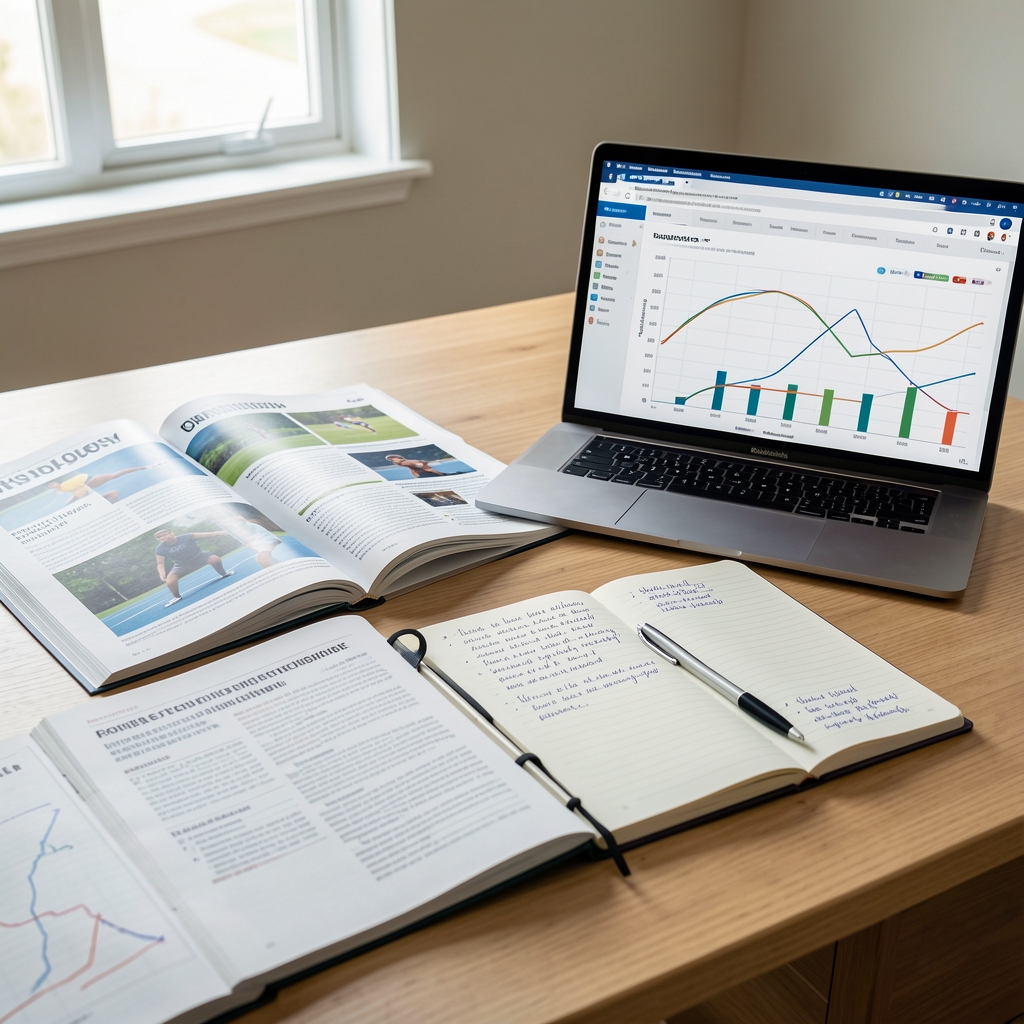
How a research page is built
The figures below describe our own editorial process, not outcomes of any study.
source tiers used when weighing a claim
editors who read each page before publication
months between scheduled reviews
business days to acknowledge a correction request
Types of evidence compared
Not all studies answer the same question. The table summarises what common designs can and cannot tell a reader.
| Design | What it does well | Typical limits |
|---|---|---|
| Systematic review and meta-analysis | Combines many studies and shows consistency across them | Quality depends on the studies included; results can hide differences between populations |
| Randomised controlled trial | Compares groups under controlled conditions | Often short, with small samples and tightly selected volunteers |
| Cohort study | Follows large groups over years and reveals associations | Cannot prove cause; lifestyle factors can overlap |
| Laboratory physiology study | Measures mechanisms such as oxygen use or muscle activation | Conditions differ from daily life |
| Expert opinion and field notes | Offers practical context and generates questions | Subjective; should not stand alone |
Where to continue reading
These entries point to pages on this site that expand on the research themes above.
Physiology primer
Energy systems, muscle fibre types and cardiovascular adaptation explained in plain language.
Longevity overview
How strength, aerobic fitness and daily movement are discussed in long-term health literature.
Field notes
First-hand observations from training floors that give context to published findings.
Reading checklist for any study
- Who took part? Check age, sex, training background and sample size. Findings from twenty young students may not describe a forty-eight-year-old office worker.
- How long did it last? Many trials run between four and twelve weeks, which says little about years.
- What was measured? A change in a laboratory marker is not the same as a change in how a person feels or performs.
- Who funded it? Funding does not invalidate a study, yet it is a reason to look for independent replication.
- Is the effect large or merely detectable? Statistical significance and practical importance are different ideas.
- Has it been repeated? One result is a lead. Several consistent results begin to form a picture.
- We prefer wording such as "is associated with" or "may contribute to" where evidence is observational.
- We avoid presenting a single trial as settled knowledge.
- We label our own interpretation as interpretation.
Research rarely hands over a plan. It offers a narrower set of reasonable options and, on a good day, a clearer way to ask the next question. Our job as editors is to keep that distinction visible to the reader, even when a tidy headline would be easier.
Common questions
Does a published study mean the result applies to me?
Not automatically. Applicability depends on how similar you are to the participants and on whether your circumstances match the study conditions. A heat-acclimation study in a climate chamber, for instance, offers helpful ideas for training in Jakarta, yet it does not replace gradual personal adjustment.
Why do guidelines change over time?
Organisations such as the World Health Organization update physical activity guidance as larger datasets and better measurements appear. Changes usually reflect refinement, not reversal. We update affected pages during scheduled reviews and note the date.
Can I suggest a source?
Yes. Send the reference through the contact page, or call +62 817 9345 1820. Suggestions are read by an editor, and accepted sources are added at the next review. Visit us at Jalan Anggrek Raya No. 15, Kemang, Jakarta Selatan 12730 by appointment. See also the editorial policy and disclaimer.